

What happens to your share of the business if you die
If you own a business with other people, here is a question most owners have never really answered. If one of you died tomorrow, what would happen to their share of the company? It sounds...
If you own a business with other people, here is a question most owners have never really answered. If one of you died tomorrow, what would happen to their share of the company? It sounds like a grim thing to dwell on, which is exactly why so few owners have. Yet the answer shapes whether the business, and both families, come through the loss in one piece. This is one of those subjects where a small piece of planning now prevents a very large problem later.
The problem hiding in plain sight
When a shareholder dies, their shares do not simply disappear, and they do not automatically pass to the other owners. They form part of the deceased’s estate, and usually pass to their family, most often a spouse. Overnight, the surviving owners can find themselves with a new business partner who never chose the role and never wanted it, while the grieving spouse finds themselves holding a stake in a company they may know little about and cannot easily turn into cash.
From there it tends to go one of two unhappy ways. The family would like to be paid out, but the remaining owners have no ready funds to buy the shares, so they raid company reserves, borrow at cost, or simply cannot raise the money. Or the family decides to keep the shares, or even to sell them to an outsider, and the people who built the business lose control of it. Neither outcome is what anyone would have chosen.
The figures show how common this exposure is. Only around a quarter of shareholders say they could readily buy the shares of a co-owner who died, which leaves roughly three quarters who could not. And more than half of small business owners have left no instructions at all in their will about what should happen to their shares.
The fix is simpler than the problem
The solution is well established and, once explained, obvious. It has two parts that work together.
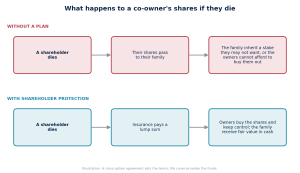
Illustration. A cross option agreement sets the terms; life cover provides the funds.
The first part is a cross option agreement between the shareholders. In plain terms, it gives the surviving owners the right to buy the deceased’s shares, and gives the family the right to require them to, at a fair value worked out in advance. Everyone knows what will happen before it ever needs to.
The second part is life cover, arranged so that a lump sum is paid out on a shareholder’s death. That money provides the cash to buy the shares, so the purchase does not drain the business or fall on the survivors personally. Put the two together and a potential crisis becomes an orderly step: the owners keep control of the company they built, and the family receives the full value of the share in cash, at the moment they most need it.
Why this matters especially for spouses
This is the very scenario where a spouse can be left in a painful position, and it is worth naming plainly. Without an arrangement in place, a widow or widower can end up as an unwilling co-owner, dependent on the goodwill and the finances of the surviving partners to release any value at all. With shareholder protection in place, that same person receives a fair cash sum without having to negotiate for it while grieving. If you built a business with a partner, putting this in place is one of the kindest and most practical things you can do for the people you would leave behind.
Where to start
You do not need to have all the answers before you begin. You need a valuation approach you are comfortable with, an agreement drawn up properly, and cover arranged to sit behind it. Our independent financial advisers at Bower Wealth put these arrangements in place for business owners regularly, working alongside your accountant and, where the agreement needs drafting, your solicitor.
If you have never decided what would happen to each owner’s share, that is worth settling while everyone is well, rather than leaving it to chance.
Bower Wealth is an independent financial adviser (IFA), whole of market and not tied to any provider. We work with business owners and families throughout the United Kingdom, including many close to home in Essex, Hertfordshire and London. Your first conversation is free and without obligation.
SOURCES
Figures are correct at the time of publication.
- Only around a quarter of shareholders say they would be able to buy the shares of a co-owner who died, leaving roughly three quarters who could not: Legal & General State of the Nation’s SMEs report.
- More than half of small business owners have left no instructions in their will about what should happen to their shares: Legal & General State of the Nation’s SMEs report.
On this page