

The person your business cannot afford to lose
Every business has at least one person it quietly depends on. Sometimes it is the owner, whose relationships and judgement hold everything together. Sometimes it is the salesperson who brings in most of the work,...
Every business has at least one person it quietly depends on. Sometimes it is the owner, whose relationships and judgement hold everything together. Sometimes it is the salesperson who brings in most of the work, or the one engineer who understands how it all fits. You know who yours is, because if you imagine them gone tomorrow, your stomach tightens. The uncomfortable truth is that most businesses have thought about losing a big client, but far fewer have planned for losing the person the business runs on.
How exposed most businesses really are
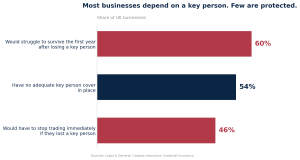
The numbers here are sobering. Nearly half of businesses say they would have to stop trading immediately if they lost a key person, and around six in ten say they would struggle to survive the first year. Yet more than half have no adequate cover in place, and a fifth of owners did not know such cover existed. So the risk is widely felt and rarely protected.
Sources: Legal & General; Caspian Insurance; Essential Insurance.
What key person cover actually does
Key person cover is straightforward once the jargon is stripped away. The business takes out a policy on the life, and usually the serious illness, of a person it depends on. The company owns the policy and pays the premiums. If that person dies or becomes seriously unwell, the policy pays a lump sum to the business.
That money buys the one thing a business never has enough of at a moment like that: time. Time to keep paying the staff and the bills while revenue recovers. Time to recruit and train a replacement rather than grabbing whoever is available. Time to reassure the bank, the customers and the rest of the team that the business will come through. Without it, a firm can be profitable on Friday and fighting for survival on Monday, purely because one irreplaceable person is suddenly not there.
Who counts as a key person
It is worth thinking broadly. A key person is anyone whose loss would seriously damage the finances of the business. In a larger company that might be a managing director, a top producer or the holder of a crucial technical skill. In a smaller company it is very often the owner, which is the case people find hardest to picture, precisely because they are so used to simply being there. If the business would feel a real financial hole without you, you are the key person, and the business has an interest in protecting itself.
Protecting the people, not just the profit
There is a human side to this that matters as much as the balance sheet. If you are the key person and the worst happens, key person cover helps the business your family may still depend on stay standing, rather than collapsing at the very moment they can least cope with it. For a couple who built the company together, and especially where one partner would be left both grieving and running the business alone, that breathing space can make all the difference. This is not about expecting the worst. It is about making sure a personal tragedy does not become a business one as well.
The right amount of cover, who it should protect, and how it fits with your other arrangements all depend on your particular business. The tax treatment can vary with the circumstances too, which is one more reason to take proper advice rather than guess. This is the kind of planning our independent financial advisers at Bower Wealth do alongside your accountant, and it is usually far more affordable than owners expect.
If there is a person your business could not comfortably do without, it is worth protecting that before you ever need to.
Bower Wealth is an independent financial adviser (IFA), whole of market and not tied to any provider. We work with business owners and families throughout the United Kingdom, including many close to home in Essex, Hertfordshire and London. Your first conversation is free and without obligation.
SOURCES
Figures are correct at the time of publication.
- Nearly half of businesses would have to cease trading immediately on the loss of a key person; around six in ten would struggle to survive the first year: Legal & General business protection research.
- Roughly one in four SMEs would have to close immediately if a key person died or became critically ill: Caspian Insurance.
- More than half of small business owners have no adequate key person cover, and around one in five did not know it existed: Essential Insurance.
On this page