

Your business is not a pension
Ask a room of company owners how they plan to fund their later life and a good number will give the same answer: the business is my pension. I understand exactly why. You have poured...
Ask a room of company owners how they plan to fund their later life and a good number will give the same answer: the business is my pension. I understand exactly why. You have poured years, savings and sleepless nights into building something valuable, and it feels natural to assume it will one day be the thing that sets you free. The trouble is that this is one of the most common plans among owners, and also one of the most exposed. Around three in ten owners intend to sell up to fund their later life, and retirement is now the reason behind roughly seven in ten business sales. A great many people are relying on the same single event going well.
Everything in one place
The first problem is concentration. Business owners commonly hold 70 to 80 percent of their net worth inside the company. That means almost everything you have is tied to one asset, exposed to your industry, your customers, the wider economy, a key employee or two, and your own health.
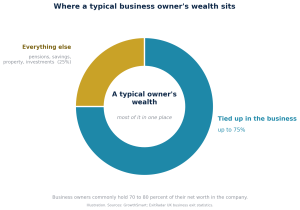
Illustration. Sources: GrowthSmart; ExitRadar UK business exit statistics.
If you held a personal investment portfolio with three quarters of it in a single share, any adviser worth their fee would raise it with you at once. Yet a great many owners carry exactly that risk without ever framing it that way, because the single holding happens to be their own company. The company may be excellent. That is not the point. The point is that having no meaningful wealth anywhere else leaves your future resting on one outcome.
The sale you are counting on may not happen
The second problem is that turning a business into cash is far from guaranteed. Of the businesses put up for sale through a broker, only around one in five actually complete a sale. The majority never find a buyer at all. Even when a sale does happen, the price and the timing are outside your control. A buyer may appear two years later than you hoped, or in the middle of a downturn, or only if you agree to stay on. If illness or a change at home forces your hand, you may have to sell in a hurry, which is rarely when the best price is on the table.
So the plan quietly depends on three things all going your way at once: that a willing buyer appears, at a fair price, at the moment you need them. Hope is not a strategy for something this important.
Build wealth alongside the business, not only inside it
None of this means the business will not be valuable, and it certainly does not mean you should care about it any less. It means the sensible course is to take some of what the business produces and build wealth outside it, steadily, over the years you are trading. A pension is the obvious and most tax efficient place to start, as I wrote about recently, and there are others alongside it. The aim is simple: to reach the point where your later life is already provided for, whatever happens to the company.
That changes everything about how the business feels. Sell it well and the proceeds become a wonderful bonus on top of a plan that was already secure. Sell it for less than you hoped, or not at all, and you are still fine. The pressure comes off the single event, because your future no longer hangs on it.
A particular word for co-owners
If you run the business with a partner or spouse, this matters twice over. It is common for a couple to pour everything into the company and for one of them, more often the woman, to have little or no provision in her own name. Building wealth outside the business, held individually as well as jointly, is one of the surest ways to make sure both of you are secure rather than only the enterprise you built together.
Where to start
You do not need to sell anything, slow the business down, or change accountants. You need a plan that treats the company as one part of your wealth rather than the whole of it, and that quietly builds security outside it while you keep doing what you do best. That is the conversation our independent financial advisers at Bower Wealth have with owners every week, working alongside your accountant.
If your entire future currently rests on one sale going perfectly, that is worth a second look before you need it to.
Bower Wealth is an independent financial adviser (IFA), whole of market and not tied to any provider. We work with business owners and families throughout the United Kingdom. Your first conversation is free and without obligation.
SOURCES
Figures are correct at the time of publication.
- Around three in ten UK business owners plan to sell their business to help fund retirement: Mazars, via Wealth & Finance International.
- Retirement is the primary driver behind roughly 69 percent of SME business sales: Asset Advantage broker survey.
- Business owners commonly hold 70 to 80 percent of their net worth in the company: GrowthSmart.
- Only around one in five businesses listed with a broker complete a sale, and the majority never find a buyer: ExitRadar UK business exit statistics, 2026.
- Around one third of SME owners are over 55: ExitRadar UK business exit statistics, 2026.
On this page