

You have an accountant. Here is why you may still need an independent financial adviser
Almost every company owner I meet has an accountant, and rightly so. A good accountant is one of the most valuable relationships in business. What surprises me is how many of those same owners have...
Almost every company owner I meet has an accountant, and rightly so. A good accountant is one of the most valuable relationships in business. What surprises me is how many of those same owners have no financial adviser at all, and have never really questioned the gap. The figures bear this out. When people set up a business, only around 13 percent take advice from a financial adviser, while nearly four in ten rely on family or friends. Owner-director retirement planning is now described as one of the most under-served areas of personal finance in the country.
Two different jobs
The reason the gap matters is that an accountant and a financial adviser do two different jobs. Your accountant records what your business has done, keeps you compliant, files your accounts and makes sure the tax is right. That work looks backwards and outwards, at the company. It is essential, and it is not the same as helping you decide what to do with the wealth you are building.
Deciding how to turn company profit into personal security, how much risk to take, how to protect your family and your business, and how to reach the point where work becomes optional, is regulated financial advice. Most accountants are not authorised to give it, and would be the first to say so. So the typical owner has hired someone to keep score, but no one to help plan the game. That is the gap Bower Wealth exists to fill, working alongside your accountant rather than in place of them.
One distinction is worth understanding when you choose that adviser. A restricted adviser works within a defined range of products or providers. An independent financial adviser (IFA) can consider the whole of the relevant market. Both are regulated, and both must recommend what is suitable for you. Bower Wealth is independent, which simply means that when we recommend something it is because we believe it is right for you, not because it is what we happen to have available.
The clearest example: profit and your pension
Nowhere is the gap more visible than pensions. Only around one in five self-employed people save into a pension at all, against roughly nine in ten employees. Among higher earners it is worse: three in five higher rate self-employed taxpayers put nothing into a pension. Many assume there is little they can do. In fact, company owners have one of the most efficient tools available to anyone.
When your company pays a pension contribution for you, it is normally treated as an allowable business expense. That means it is deducted before corporation tax, and it carries no National Insurance for the company or for you. Compare that with taking the same profit as a dividend, where corporation tax is paid first and dividend tax second. The difference is striking.
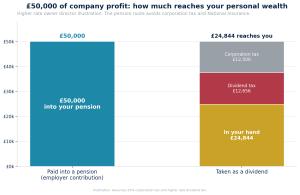
Illustration. Assumes 25% corporation tax and higher rate dividend tax.
The illustration follows £50,000 of company profit for a higher rate owner. Paid into a pension, the full £50,000 goes to work for your future. Taken as a dividend, corporation tax and dividend tax between them leave closer to £24,844 in your hand. Same starting figure, very different destination.
There are two honest points to add. Money in a pension is normally locked away until age 55, rising to 57, so this is long-term money, not next year’s cash flow. And it is taxed when you draw it, although usually a quarter can be taken tax free and many people pay tax at a lower rate in later life than they did while working. There are also annual limits on how much can go in. None of this weakens the case. It is precisely the kind of judgement an adviser is there to help you weigh.
It matters even more for women who own businesses
The advice gap is wider still for women who own or co-own companies. Women are less likely to have pension provision in their own name, and in couples who run a business together it is often the woman whose long-term security is left to chance. If you built the company alongside a partner, it is worth asking whether both of you, and not just the business, are being provided for.
Where to start
You do not need to change accountants, and you certainly do not need to understand every rule before you begin. You need one conversation that looks at your business and your personal position together, and turns the profit you have worked hard for into lasting security for you and your family. That conversation is what our independent financial advisers at Bower Wealth do every day, and we are always glad to work hand in hand with your accountant.
If you own a company and have never had that conversation, it may be the most valuable hour you spend this year.
Bower Wealth is an independent financial adviser (IFA), whole of market and not tied to any provider. We work with business owners and families throughout the United Kingdom. Your first conversation is free and without obligation.
SOURCES
Figures are correct at the time of publication.
- 1. Only around 13 percent take advice from a financial adviser when setting up a business, and nearly four in ten rely on family or friends: smallbusiness.co.uk, 2024.
- 2. Around one in five self-employed people save into a pension, against roughly nine in ten eligible employees: Institute for Fiscal Studies.
- 3. Three in five higher rate and almost half of additional rate self-employed taxpayers are not contributing to a pension: IFA Magazine, 2025.
- 4. Owner-director retirement planning described as one of the most under-served areas of personal finance: Business Matters Magazine, 2025.
- 5. Pension and dividend illustration assumes 25 percent corporation tax and higher rate dividend tax; figures depend on rules and rates that can change.
On this page