
The quiet cost of keeping too much in cash
Cash feels safe. It is the money you can see, the balance that never falls, the buffer that helps you sleep at night. I understand the appeal completely, and a healthy cash reserve is part...
Cash feels safe. It is the money you can see, the balance that never falls, the buffer that helps you sleep at night. I understand the appeal completely, and a healthy cash reserve is part of almost every sensible financial plan. What worries me is how much cash sits well beyond that reserve, quietly losing value while its owner assumes it is doing no harm.
The numbers are striking. Households across the United Kingdom hold around £1.9 trillion in cash deposits, and roughly seven pounds in every ten sit in easy access accounts. A large share earns very little. More than £338 billion is held in accounts paying 1.5 percent or less, and by the middle of last year around eight million accounts were paying one percent or under. During 2025 alone, savers lost close to £7 billion of spending power to inflation. That is not a market crash anyone reported on. It is a slow leak, and most people never feel it happen.
Inflation is the part everyone feels
The first force wearing your cash away affects every saver in the same way, whatever you earn. It is inflation. In the year to June 2026 the Consumer Prices Index rose by 2.6 percent. That means a basket of goods costing £100 today will cost around £102.60 in a year. If your savings are not growing by at least that much, your money buys a little less every year, even though the number in your account has not moved.
Tax then takes its share
The second force is tax, and here your position does matter, though perhaps less than you might expect. Everyone has a Personal Savings Allowance: the first £1,000 of interest is tax free for a basic rate taxpayer, and the first £500 for a higher rate taxpayer. Interest above that is taxed at your usual rate.
So an account advertising 4.5 percent does not hand everyone 4.5 percent. For a basic rate taxpayer the return after tax is nearer 3.6 percent. For a higher rate taxpayer it is closer to 2.7 percent. On a low paying account of 1.5 percent, the after tax return is around 1.2 percent for a basic rate taxpayer and 0.9 percent for a higher rate taxpayer.
What that looks like
The chart below shows £50,000 over twenty years in today’s money. That is worth pausing on, because it makes everything easier to read. Rather than showing a number that grows while prices grow behind it, every line is expressed in what the money would actually buy. The flat line is £50,000 holding its spending power exactly. Anything below it has lost ground.
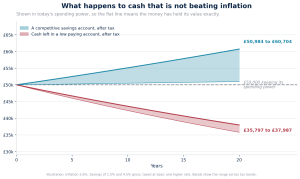
Illustration. Inflation 2.6%. Savings of 1.5% and 4.5% gross, taxed at basic and higher rate.
Cash left in a low paying account falls to somewhere around £36,000 to £38,000 of today’s money. It still says £50,000 on the statement, but it buys a quarter less. A competitive account does far better, landing at roughly £51,000 to £61,000, but notice how modest that is: for a higher rate taxpayer it is barely above the line. Even a good savings rate, once tax is taken, does little more than tread water.
The allowance most people are not using
There is an obvious step that costs nothing and is often overlooked. Interest inside an ISA is not taxed at all, so the tax drag simply disappears. The allowance is £20,000 for the 2026/27 tax year, which means a £50,000 pot takes three tax years to shelter fully: £20,000, then £20,000, then the remaining £10,000. A couple with two allowances could do it in two.
There is also a change coming that is worth knowing about now rather than later. From 6 April 2027, announced at the Autumn Budget in 2025, the amount that can go into a cash ISA falls to £12,000 a year for anyone under 65. The overall £20,000 ISA allowance is unchanged, so the balance can still be sheltered, but it would need to go into a stocks and shares ISA, an Innovative Finance ISA or a Lifetime ISA instead. If you are 65 or over, the cash limit stays at £20,000.
In other words, the window for moving large amounts of cash into a cash ISA is a little wider now than it will be. That is not a reason to rush, but it is a reason to look.
And if the money is genuinely long term
Sheltering cash from tax fixes one of the two problems. It does not change the fact that cash tends to grow slowly. For money you will not need for many years, it is worth understanding what the long record shows.
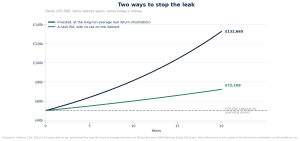
Illustration. Past performance is not a guide to the future and investments can fall as well as rise.
The cash ISA line reaches about £72,000 of today’s money, simply by removing the tax. The investment line is different in kind, and I want to be careful about it. It uses the long-run average real return on United Kingdom shares since 1899, which the Barclays Equity Gilt Study puts at around 5 percent a year after inflation. On that basis £50,000 would have grown to roughly £133,000 in today’s money.
That is a historical average, not a forecast, and it is not a smooth ride. It contains wars, crashes and long stretches where the value fell and stayed down. Investments can fall as well as rise and you may get back less than you put in, which is precisely why this is money you should only commit if you can genuinely leave it alone. Cash does not do that to you, and that is its virtue.
There is a simple piece of arithmetic worth knowing here, often called the Rule of 72. Divide 72 by your yearly return and you get the rough number of years it takes for money to double. At the long-run real return of around 5 percent, that is roughly fourteen years to double in real spending power. At the after tax return on a low paying account, it never doubles at all. It shrinks.
Where this leaves you
None of this means cash is the enemy. It means cash has a job, and holding far more than that job requires has a cost that is easy to miss. The order of the questions is usually the same: how much do you need to keep accessible, is the rest earning a competitive rate, is it sheltered from tax where it can be, and is any of it long term enough to be doing something else entirely.
The right answers depend on your goals, your timescale and how you feel about risk. That is a conversation worth having properly, and it is exactly the kind of conversation our independent financial advisers at Bower Wealth have every day.
If you have a meaningful amount of cash sitting still and you are not sure whether it is working hard enough for you, we would be glad to talk it through.
Bower Wealth is an independent financial adviser (IFA), whole of market and not tied to any provider. We work with business owners and families throughout the United Kingdom. Your first conversation is free and without obligation.
SOURCES
Figures are correct at the time of publication.
1. Cash deposits of around £1.9 trillion, roughly 70 percent in easy access accounts: Bank of England, via money.co.uk Savings Statistics 2025.
2. More than £338 billion held in accounts paying 1.5 percent or less, and around eight million accounts paying 1 percent or under: MoneyWeek, 2025.
3. Savers lost close to £7 billion of spending power to inflation in 2025: GB News, 2025.
4. Consumer Prices Index rose 2.6 percent in the year to June 2026: Office for National Statistics.
5. ISA allowance of £20,000 for 2026/27, and the reduction of the cash ISA allowance to £12,000 for those under 65 from 6 April 2027, announced at Autumn Budget 2025.
6. Long-run average real return on UK equities of approximately 5 percent a year since 1899: Barclays Equity Gilt Study.
On this page