

What independent financial advice actually means
If you have started looking for financial advice, you will have come across two words that sound like marketing but are in fact regulated terms with specific meanings: independent and restricted. Very few people are...
If you have started looking for financial advice, you will have come across two words that sound like marketing but are in fact regulated terms with specific meanings: independent and restricted. Very few people are ever told the difference, which is a shame, because it is simple, it is worth knowing, and you are entitled to ask about it.
The difference, in one line
An independent adviser can consider the whole of the relevant market. A restricted adviser works within a defined range, which might be certain types of product, or the products of a single provider.
That is genuinely the whole distinction. It is about how wide a range the adviser is able to look across, rather than anything about how good they are at their job, how qualified they are, or how much they care about their clients.
What is the same, and it matters
It would be easy, and unfair, to leave you with the impression that one of these is somehow better regulated than the other. It is not. Both independent and restricted firms are authorised and regulated by the Financial Conduct Authority. Both must recommend what is suitable for you. Both are subject to the Consumer Duty, which requires firms to act to deliver good outcomes for their customers. There are excellent restricted advisers, and for many people a restricted firm will do a perfectly good job.
What regulation does, and what it does not do
While we are being clear, this is worth saying plainly, because the word safe gets used far too loosely in this industry. Regulation sets standards a firm has to meet. It gives you the right to complain to the Financial Ombudsman Service if you are unhappy, and it brings the protection of the Financial Services Compensation Scheme within its limits. What it does not do is make advice safe, or make any investment safe. Values rise and fall. A recommendation made carefully and in good faith can still turn out badly. Regulation gives you standards and a route to recourse, not certainty, and anyone who suggests otherwise is overselling it.
So when does it matter?
It matters when the right answer for you happens to sit outside the range your adviser can access. A restricted adviser will recommend the most suitable option available to them, which is exactly what the rules require. An independent adviser is able to look wider. Whether that difference is significant depends entirely on your circumstances, but it is the sort of thing that is easier to think about at the beginning than to unpick later.
It can also matter for cost and for choice over time. The wider the range under consideration, the more scope there is to match the solution closely to your particular circumstances.
The easiest thing you can do
Ask. Every firm giving this kind of advice has to tell you whether it is independent or restricted, and a restricted firm has to explain the nature of its restriction. You do not need to be confrontational or knowledgeable about the rules. One question covers it.
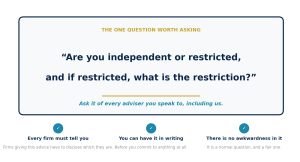
Every firm giving retail investment advice must disclose whether it is independent or restricted.
You should get a straight answer, and you are entitled to it in writing before you commit to anything. There is no awkwardness in asking. It is a normal, sensible question, and any good adviser will be pleased you did.
Where Bower Wealth sits
We are independent. That means we are whole of market and not tied to any provider, so we are free to consider anything that might suit you. We think that matters, but you should not simply take our word for it. Ask us the question, and ask it of anyone else you speak to.
If you would like to talk something through, your first conversation is free and without obligation, and there is no expectation that it leads anywhere.
Bower Wealth is an independent financial adviser (IFA), whole of market and not tied to any provider. We work with business owners and families throughout the United Kingdom. Your first conversation is free and without obligation.
SOURCES
Figures are correct at the time of publication.
- Financial Conduct Authority Handbook, COBS 6.2B, Describing advice services.
- Financial Conduct Authority Consumer Duty (PRIN 2A), which requires firms to act to deliver good outcomes for retail customers.
On this page